
Signs Your AC Unit Needs to Be Replaced — Not Just Repaired

Air conditioners don't usually fail all at once. They give you signs — a gradual decline in performance, rising energy bills, more frequent service calls — before they finally give out. The problem is that these signs are easy to dismiss, especially when a technician can patch things up for a few hundred dollars each time.
But there comes a point where repair costs are eating into the money you'd save by simply replacing the system. Knowing when you've crossed that line is one of the most valuable things a homeowner can understand about their HVAC system.
Long Energy has been installing and servicing air conditioning systems across the Capital Region since 1945. Here are the signs we look for when helping homeowners make this decision.
Your system is more than 15 years old
The average central air conditioning system has a lifespan of 15 to 20 years with proper maintenance. If your system is in that range or beyond, it's operating at the tail end of its designed life. Even if it's still technically running, an aging system is significantly less efficient than modern units — and the older it gets, the more likely you are to face costly component failures.
Systems installed before 2010 also likely use R-22 refrigerant, which has been phased out under federal environmental regulations. R-22 is no longer manufactured in the U.S. and the remaining supply is expensive and dwindling. If your system uses R-22 and needs a refrigerant recharge, the cost alone often makes replacement the more economical choice.
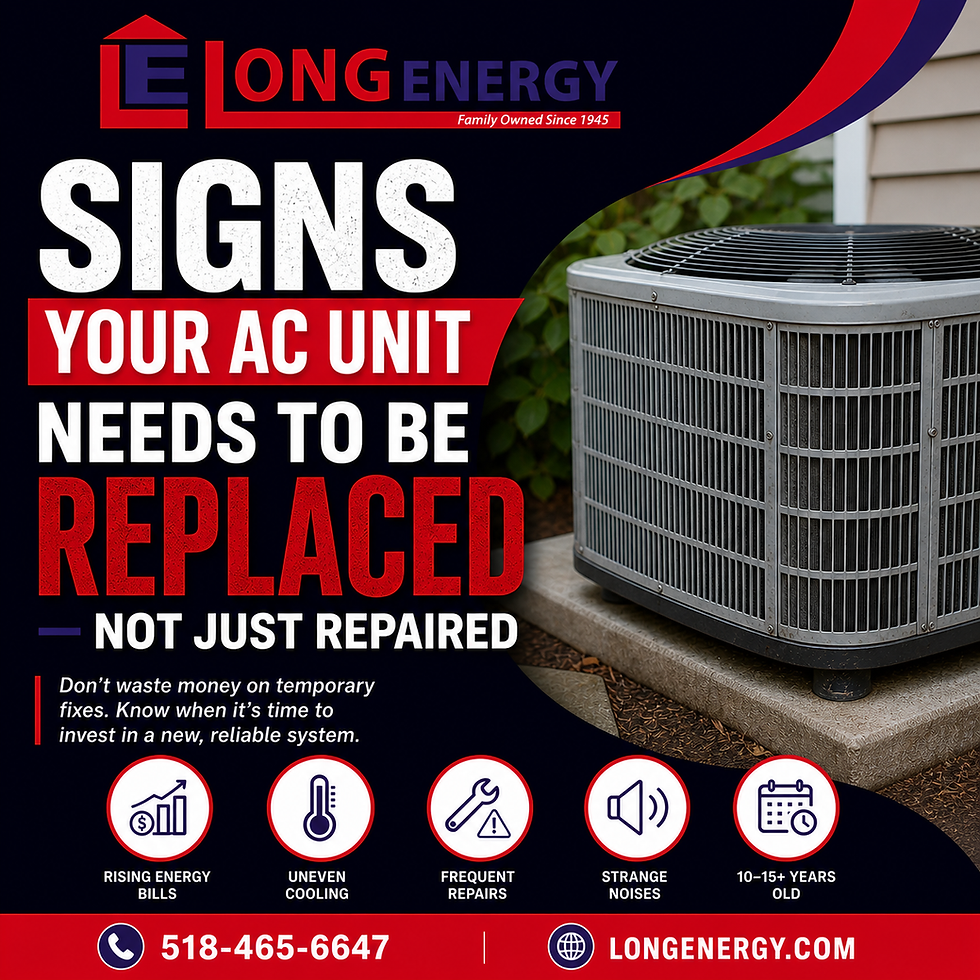
You've had two or more repairs in the past two years
One repair is normal. Two or more in a short period is a pattern. When components start failing in succession — capacitors, contactors, fan motors, refrigerant leaks — it's usually a sign that the system as a whole is degrading. Each repair buys a little more time, but you're essentially paying to extend the life of equipment that's already past its peak.
A useful rule of thumb is the 5,000 rule: multiply the age of the system in years by the estimated repair cost. If the result exceeds $5,000, replacement is generally the better financial decision. For example, a 12-year-old system facing a $500 repair scores 6,000 — lean toward replacing. A 4-year-old system facing the same repair scores 2,000 — repair it.
Your energy bills have been creeping up
Air conditioners lose efficiency as they age, even with regular maintenance. Dirty coils, worn components, refrigerant loss, and degraded insulation all add up to a system that has to work harder to produce the same cooling output. If your summer energy bills have been noticeably higher over the past few years without a clear explanation, your AC's declining efficiency is likely a contributing factor.
Modern high-efficiency systems with SEER2 ratings of 16 or higher can reduce cooling energy consumption by 20 to 40 percent compared to a 15-year-old system. Over a 10 to 15 year lifespan, those savings add up to thousands of dollars — and available rebates from NYSERDA and federal tax credits can significantly offset the upfront replacement cost.
Your home no longer cools evenly
Hot spots, rooms that never quite reach the thermostat temperature, or one floor that's dramatically warmer than another — these are signs that your system is either undersized for current conditions, losing capacity due to age, or struggling with duct issues. If a duct inspection rules out airflow problems and the system is aging, uneven cooling is a strong indicator that the equipment itself is no longer performing adequately.
It runs constantly but still can't keep up
A properly functioning air conditioner should cycle on and off to maintain your set temperature. If yours runs almost continuously on hot days and still struggles to keep the house comfortable, it's working at or beyond its capacity. This could reflect a system that's undersized, one that's lost significant efficiency, or one with a refrigerant issue. In any of these cases, a system evaluation is warranted — and replacement is often the outcome.
It's making new or unusual noises
Banging, grinding, squealing, or rattling that wasn't there before points to worn mechanical components — bearings, belts, fan blades, or compressor issues. A rattling outdoor unit might mean loose hardware. Grinding or squealing often indicates bearing failure in the fan motor or blower. These sounds don't resolve themselves and tend to escalate into larger failures if ignored.
The compressor has failed
The compressor is the heart of your AC system and its most expensive component. A compressor replacement on an older system can cost $1,500 to $2,500 or more — and if the system is already aging, putting that investment into aging equipment rarely makes financial sense. In most cases where a compressor has failed on a system more than 10 years old, replacement of the full system is the right call.
When repair still makes sense
Not every AC issue signals replacement. If your system is under 10 years old, well-maintained, and experiencing a single component failure — a capacitor, contactor, thermostat, or refrigerant recharge with a current refrigerant — repair is almost always the right answer. Regular annual maintenance significantly extends system life and keeps small issues from becoming big ones.
Get an honest assessment from Long Energy
Long Energy's certified HVAC technicians serve homeowners across Albany, Schenectady, Saratoga, Rensselaer, Columbia, Greene, and surrounding counties. When you call us for a service evaluation, we give you a straight answer — whether that's a repair recommendation or an honest conversation about whether replacement makes more sense for your situation.
Is your AC giving you trouble? Contact Long Energy today for an honest evaluation — Where Service Counts.

Comments